Construction & Design
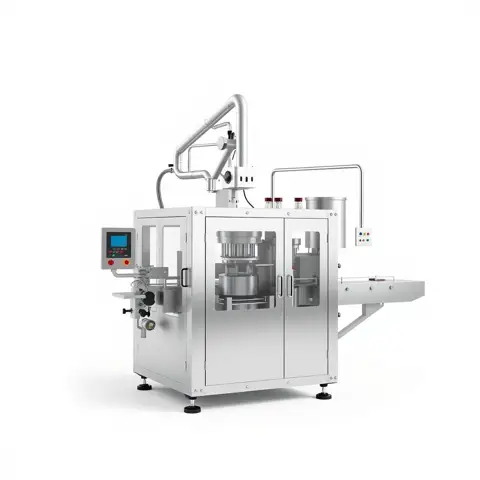
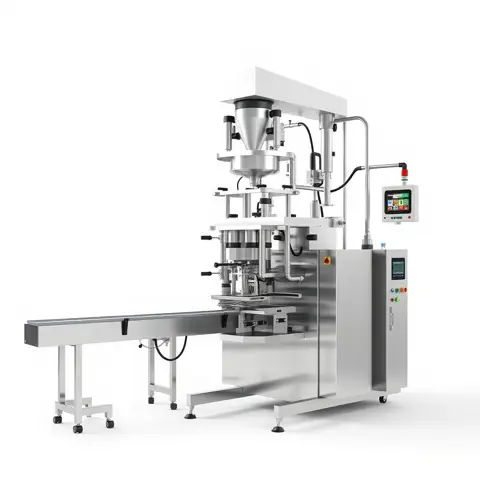
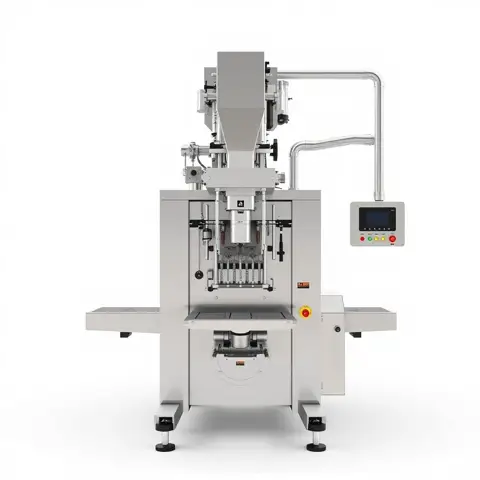
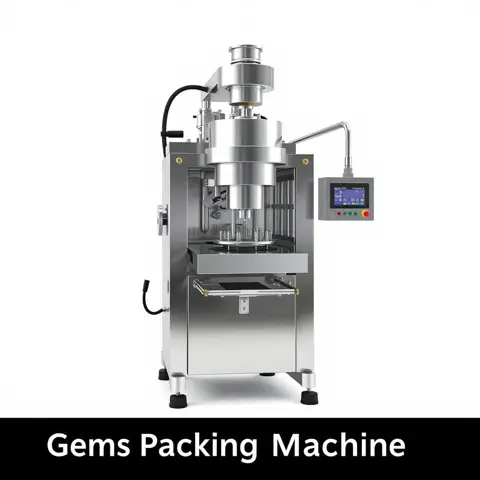
The machine is designed around the main stages of pouch packaging, including product feeding, filling, sealing, and pouch discharge. Its construction and component arrangement depend on the selected model and application requirements.
For food-product packaging, the design should allow practical access to areas that require cleaning, inspection, adjustment, and routine maintenance. Product-contact components and other construction details can be considered according to the application and machine configuration.
The overall arrangement can also vary according to the available installation space, pouch dimensions, filling requirements, and integration with upstream or downstream equipment.
Working Process
The working cycle generally begins with the supply of packaging material and preparation of the pouch-forming or pouch-feeding system. Sev is supplied to the filling section through the configured product feeding arrangement.
The required quantity or filling condition is established according to the selected machine configuration. The product is then introduced into the pouch while maintaining the intended packaging sequence.
After filling, the pouch moves to the sealing section. The packaging material is sealed using the configured sealing arrangement. The finished pouch is then separated or discharged for collection, inspection, secondary packing, or further handling.
The exact sequence, filling method, controls, and operating parameters depend on the machine configuration selected for the application.
Industrial Applications
A Sev Pouch Packing Machine can be used by businesses involved in:
- Namkeen and snack manufacturing
- Sev production and packaging
- Retail snack packaging
- Food-product processing units
- Snack distribution and private-label operations
- Packaged food manufacturing
- Institutional and commercial snack supply
The machine can also be considered for related free-flowing snack products where the filling and packaging requirements are compatible with the selected configuration.
Key Benefits
- Reduces dependence on repetitive manual pouch-packing operations.
- Supports a more organized and systematic packaging workflow.
- Helps maintain consistency across packaged units when properly configured.
- Provides a practical solution for retail-oriented sev packaging.
- Can be configured for different pouch and product requirements.
- Supports easier integration of filling, sealing, and pouch discharge operations.
- Helps packaging teams manage production activities more efficiently.
Performance & Reliability
Reliable operation depends on correct machine selection, suitable packaging material, appropriate product characteristics, regular cleaning, and proper operating practices. Sev can differ in particle size, texture, density, and seasoning, so the filling arrangement should be selected according to the actual product.
Routine inspection of sealing components, product-contact areas, feeding mechanisms, sensors, and other operating parts can help maintain consistent machine operation. Operators should follow the manufacturer's operating and maintenance instructions and use machine settings appropriate to the selected packaging material and product.
For industrial buyers, evaluating the machine against actual pouch dimensions, required pack weights, production workflow, available floor space, and integration requirements is important before finalizing a configuration.
Why Choose Durga Packaging Machine?
Durga Packaging Machine provides packaging machinery solutions for businesses seeking practical automation for food and other packaging applications. For a sev packaging requirement, the machine configuration can be discussed according to the product characteristics, pouch format, filling requirement, packaging material, and production environment.
As Sev Pouch Packing Machine Manufacturers in Vadodara, Durga Packaging Machine can assist buyers in identifying a suitable machine configuration based on their application rather than relying on a one-size-fits-all arrangement. Buyers can discuss their product, pouch size, required filling range, packaging material, and operational requirements before selecting the machine.
This approach is useful for manufacturers, procurement teams, snack-processing businesses, exporters, and other industrial buyers looking for a packaging system suited to their specific production needs.